AAC and 3D Concrete Printing – How Modern Inline Measurement Technology Optimizes Production Processes
-
 Fluid.iO Sensor + Control GmbH & Co. KG
- May 7, 2026
- 8
- 5.2 minutes
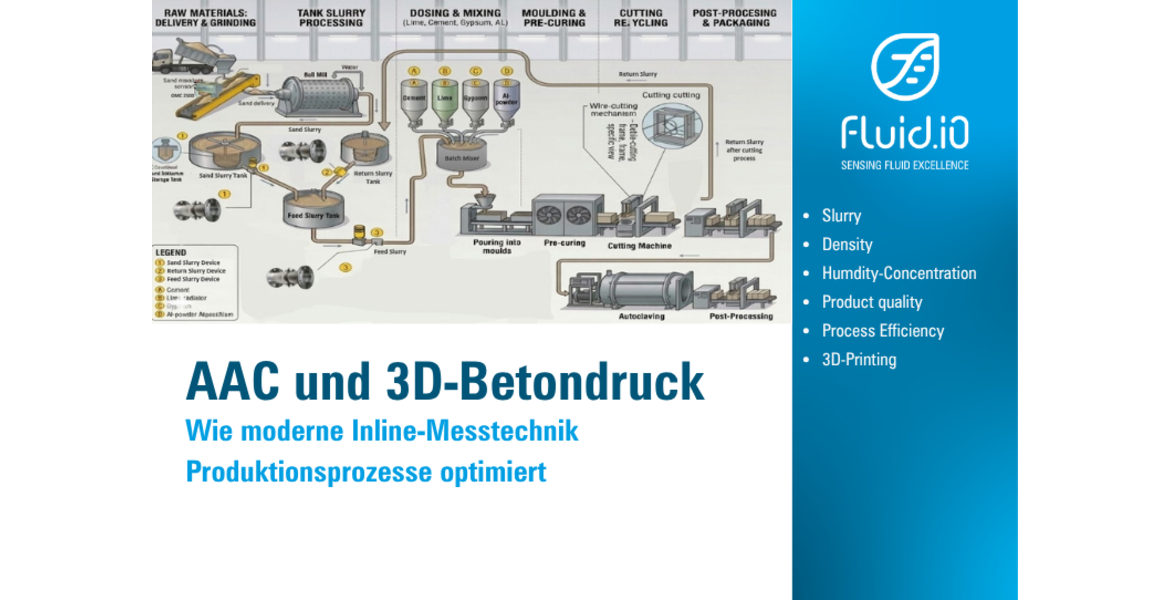
The building materials industry is facing increasing pressure to make production processes more efficient, sustainable, and stable. Precise inline measurement methods are gaining ever-greater importance, particularly in the production of autoclaved aerated concrete (AAC) and in the field of 3D concrete printing.
Continuous process data enables significantly better control of critical production parameters and helps reduce quality fluctuations, scrap, and unnecessary resource consumption.
AAC – A Growing Market with High Demands
AAC ranks among the most important modern building materials worldwide. This lightweight yet thermally insulating material is produced from sand, lime, cement, gypsum, aluminum powder, and water.
With thousands of production facilities operating globally, the demand for automated and stable production processes is continuously growing.
At the same time, requirements are increasing regarding:
- Product Quality
- Energy Efficiency
- Material Usage
- Process Stability
Even minor deviations in composition can significantly influence the properties of the finished building material. Therefore, knowledge of both the process conditions and the medium itself is essential. Inline process measurement technology can assist manufacturing companies in detecting changes in process conditions at an early stage and in better controlling the process.
Critical Process Parameters in AAC Production
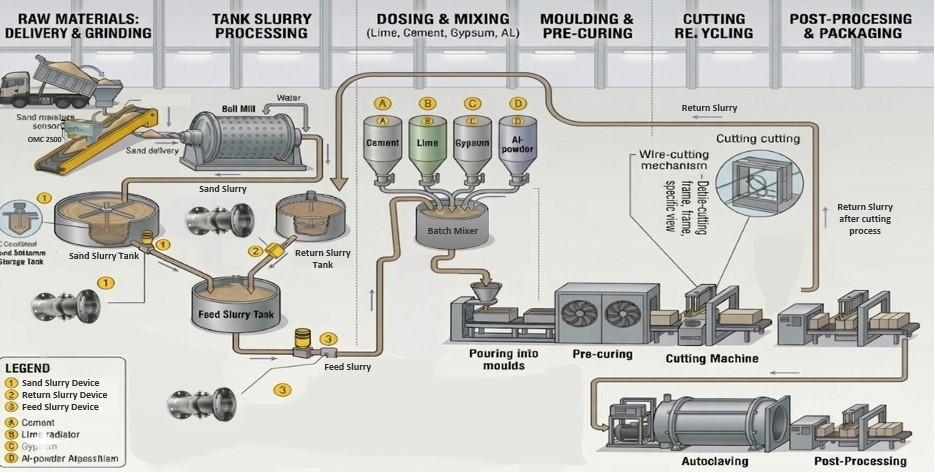
Moisture and density are particularly relevant within the manufacturing process.
Moisture Measurement of Sand
Prior to the grinding process, the sand is fed to the ball mill via conveyor technology. The moisture content of the material directly influences:
- Grinding behavior
- Energy consumption
- Particle size
- Stability of the resulting slurry
Sand that is too dry complicates processing and increases energy consumption. Conversely, sand that is too wet leads to unstable mixing ratios.
In many production facilities, monitoring is still carried out via manual laboratory sampling at infrequent intervals. As a result, process deviations are often detected only with a delay. A suitable and more efficient approach involves the use of inline process measurement technology—particularly for determining residual moisture and density.

OMC 2500
Online Moisture Control
reliably and precisely determine the moisture or dry mass of bulk materials, suspensions or pasty materials online in the process
- digital noise filtering
- pre-programmed algorithms and calibrations
- integrated contamination detector for the measuring window
Inline Density Measurement for Stable Slurry Processes
Another crucial parameter is the density of the sand slurry.
It influences, among other things:
- Pore formation
- Strength
- Mixing behavior
- Curing process
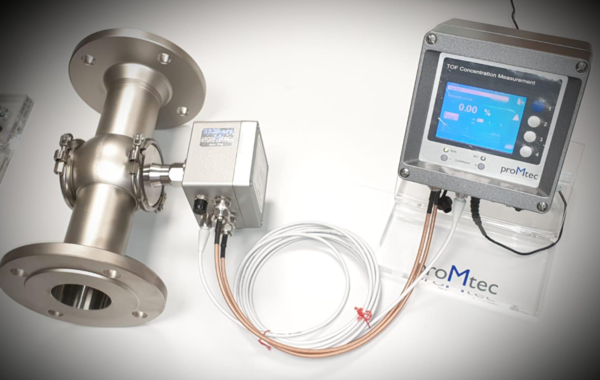
TOF 1500
Inline Concentration Control
precise determination of the concentration or density of liquids by measuring the time of flight in the medium
- Precise concentration measurement
- reliable and continuous analysis directly within the process
- Measurement principle of time of flight
Even minor deviations in density can lead to reduced quality or unstable production conditions. In the worst-case scenario, this results in a defective batch. Continuous inline density measurement enables a significant improvement in process control in this regard.
Microwave-based Inline Measurement Technology
Modern microwave measurement systems enable the continuous monitoring of density and concentration directly within the ongoing process.
In this process, microwaves penetrate the entire cross-section of the pipe. Changes in attenuation and phase shift correlate directly with the water content, density, and concentration of the medium.
Compared to conventional measurement methods, this offers several advantages:
- wear-free measurement, even with abrasive media
- no bypass solutions required
- measurement directly within the main flow
- low-maintenance operation
- high reproducibility and process stability
As a result, production deviations can be detected and corrected immediately.
Key Measurement Points within the Process
Continuous monitoring is particularly beneficial at several points within the plant:
- downstream of the sand slurry tank
- upstream of the main mixer
- in the area of return or recycled slurries
This enables the stabilization of recipes and allows for the early compensation of fluctuations.
Continuous Moisture Measurement with NIR Technology
Complementing density measurement, Near-Infrared (NIR) technology is frequently employed for continuous moisture measurement.
The measurement is performed directly on the conveyor belt and enables:
- rapid detection of material fluctuations
- optimized water addition
- more stable mixing processes
- reduced reject rates
The combination of moisture and density measurement significantly enhances process reliability.
3D concrete printing poses new demands
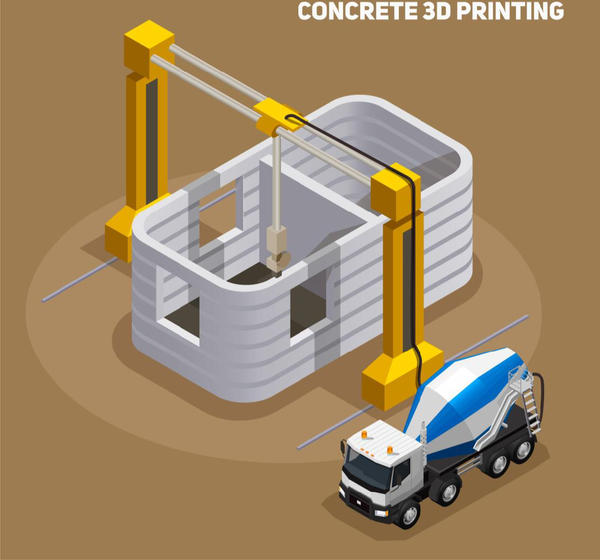
Process measurement technology is playing an increasingly important role in the field of 3D concrete printing as well.
The materials used must simultaneously be:
- pumpable
- flowable
- and dimensionally stable immediately after extrusion
In this context, the following parameters are particularly critical:
- Density
- Consistency
- Water-to-cement ratio
Since the materials are highly abrasive, many conventional sensor systems quickly reach their limits.
Advantages of Contactless Inline Measurement Technology in 3D Concrete Printing
Non-contact measurement methods offer decisive advantages in this context:
- no mechanical wear
- stable real-time measurement
- continuous process monitoring
- direct integration into mixing and pumping systems
Potential measurement points range from the pre-mixing stage, through pumping and transport systems, to the extruder or print nozzle. In many cases, the requirements from the AAC sector can be directly applied to 3D concrete printing processes.
Summary
The building materials industry is increasingly shifting toward data-driven and automated production processes. Modern inline measurement technology establishes the foundation for:
- higher product quality
- more stable processes
- more efficient resource utilization
- reduced production costs
Particularly in demanding applications—such as AAC production and 3D concrete printing—continuous real-time monitoring is becoming a decisive success factor.
Fluid.iO offers suitable process measurement technology for these applications.
Similar Products


Our application engineers advise you personally, comprehensively and professionally!
Simply contact us by phone or e-mail!