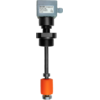
Level sensors type T-20_.F... are
approved by the DIBt (German
Institute for Structural Engineering) as liquid level limit switches for the overcharge protection of containers for storing water-dangerous liquids.
Connection
Box
:
Polyester
Box
:
Aluminium
Box
:
Polyethylen
Box
:
Kabel
Box
:
Stecker
Properties
Protection class EN60529
:
IP 65
connection thread
:
G 1", G 1¼", G 1½", G2", G3”
Union nut
:
G 2¾", S 100x8
Guide tube length
:
max. 6 m
Operating temperature
:
atmosphärisch; PP max. 90°C
Operating pressure
:
Max. 20 bar
media density
:
ρ ≥ 0,6 g/cm³ (je nach Schwimmertyp)
Switching hysteresis
:
typ. 2 mm
Switching point tolerance
:
max. 2 mm
Resistance value
Operational readiness
:
ca. 1 kΩ
overfill alarm
:
ca. 12 kΩ
Switching time
:
ca. 20 ms
ltdata.
:
HD-1XX
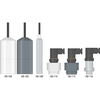
Hydrostatic filling level measurement
Continuous and precise level measurement in unpressurised, open basins and tanks as well as underground applications such as shafts, wells and boreholes.
NSP-X-E
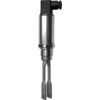
Vibrating Limit Switch
The vibrating limit switch is a level limit switch for all kinds of fluids and is used in tanks, containers and pipelines.
Properties
Protection class EN60529
:
IP 65/IP 67
Operating pressure
:
≤ 40 bar
media density
:
ρ ≥ 0,7 g/cm³
Viscosity
:
max. 10000 mm²s
Rated current
:
< 15 mA
Protection class
:
III
Output
:
PNP
power
:
kurzschlussfest, überlastsicher
Display
:
LED (grün, rot)
Switching delay (cover)
:
ca. 0,5 s
Switching delay (release)
:
ca. 1 s
NSP-1-E
connection thread
:
G 1”
Operating temperature
:
–40...+150 °C
Storage temperature
:
–40...+85 °C
nominal voltage
:
10...55 V DC (verpolsicher)
Current output
:
≤ 350 mA
NSP-2-E
connection thread
:
G ½”
Operating temperature
:
–40...+100 °C
Storage temperature
:
–20...+70 °C
nominal voltage
:
10...35 V DC (verpolsicher)
Current output
:
≤ 250 mA
T206
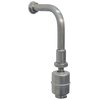
Magnetic immersion probes made of PP or stainless steel (1.4571)
Magnetic immersion probes for use with highly aggressive liquid media for detecting level limits in containers
Properties
Number of contacts
:
1 x Schließer/Öffner durch 180°-Drehung des Schwimmers