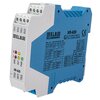
The contact protection relays are universal measuring transducers, which
input signals (resistance values) with "Namur" specification (DIN EN 60947).
Namur" specification (DIN EN 60947) into switching signals of floating
output contacts.
Protection class EN60529
clamp
:
IP20
Housing
:
IP40
Technical Data
Operating temperature
:
-20...+60 °C
Storage temperature
:
-30...+80 °C
Output contacts
:
potentialfrei
Switching voltage
:
min. 5 V, max. 250 V AC / 150 V DC
Switching current
:
min. 5 mA, max. 5 A AC / 5 A DC
Switching capacity
:
min. 300 mW, max.100 VA / max. 50 W
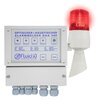
Alarm Indicator (Measuring Transducer) with general approval for construction
Our alarm indicators type OAA-300 are stand-alone signaling devices with optic and acoustic alarm indication.
Properties
Protection class EN60529
:
IP 65
Operating temperature
:
– 20…+60 °C
Storage temperature
:
– 30…+80 °C
Sensitivity
:
bei konduktiver Messung: 3, 10, 30, 100kΩ
Dimensions
:
170 x 190 x 85 mm
Weight
:
ca. 0,8 kg
Control circuits
Open circuit voltage
:
max. 10 V DC
Short-circuit current
:
max. 10 mA
Switching delay
:
ca. 0,5 s
Power supply
nominal voltage
:
230 V AC (optional 24, 115, 240 V AC 24 V DC
Nominal frequency
:
48...62 Hz
Power consumption
:
max. 3 W/VA
Output
Switching voltage
:
max. 250 V
Switching current
:
max. 3 A
Switching capacity
:
max. 500 VA | max. 50 W
Volume
:
75 dB
HD-100 | HD-102 | HD-104
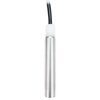
Hydrostatic immersion probes (0.8...10mWS)
Continuous and precise level measurement in unpressurised, open basins and tanks as well as underground applications such as shafts, wells and boreholes.
Properties
Protection class EN60529
:
IP68
Operating temperature
:
-10...70 °C (PVC: -10...60 °C)
Storage temperature
:
-25...70 °C (PVC: -10...60 °C)
Power supply
:
15...30 V DC
power
:
max. 25 mA
Output
:
2-Leiter-Technik
Measuring range
:
0,8...10 mWs (Standard)
Overpressure
:
abhängig vom Messbereich
Deviation from characteristic curve
:
Nichtlinearität,
Insulation resistance
:
> 100 kΩ
Short-circuit resistance
:
permanent
Reverse polarity protection
:
keine Schädigung o. Funktion bei vertauschten Anschlüssen