From Black Mass to Cathode Material: How Inline Concentration Measurement Makes CAM Production More Efficient
-
 Fluid.iO Sensor + Control GmbH & Co. KG
- 29 sept. 2026
- 4
- 7.3 minutes
Electromobility is growing rapidly—and with it, the demand for high-performance lithium-ion batteries. To reduce dependence on Asian supply chains, Europe is currently investing heavily in establishing its own battery value chain. New production facilities for cathode active materials (CAM) are being built in countries including Germany, Finland, Poland, and Spain. However, as production capacities rise, so does the importance of stable and efficient manufacturing processes. Even minor deviations in the concentration of metal ions or solids can affect the quality of the resulting cathode material and thereby impair battery performance. Precise process monitoring is therefore becoming a crucial factor for success.
What are Cathode Active Materials (CAM)?
Cathode Active Materials (CAM) form the active component of the cathode in a lithium-ion battery. They play a key role in determining the battery’s properties and have a direct impact on:
-
Energy density
-
Service life
-
Charging speed
-
Safety
-
Performance
Depending on the battery type, CAM may consist of combinations of:
-
Lithium
-
Nickel
-
Cobalt
-
Manganese
-
Aluminum (depending on the cell chemistry)
The production of these materials involves several coordinated process steps. Consistently high product quality is essential, as even minor variations during production can affect the subsequent performance of the battery.
Europe Invests in CAM Production
To meet the growing demand for batteries for electric vehicles, numerous production facilities for cathode active materials are currently being developed across Europe.
Some of the key projects include:
| Company | Location | Status |
| BASF | Schwarzheide (Germany) | In production |
| IONWAY (PowerCo & Umicore) | Nysa (Poland) | Under construction |
| Easpring Finland | Kotka (Finland) | Under construction |
| Hunan Yuneng | Mérida (Spain) | Construction permit granted |
All of these plants share a common goal: to produce high-quality cathode materials as efficiently and resource-consciously as possible while ensuring consistent product quality.
As a result, process measurement technology is becoming increasingly important in modern production facilities.
Where Do the Biggest Challenges Arise?
The production of cathode active materials involves numerous process steps – from raw material preparation to the finished product.
Throughout the entire manufacturing process, various parameters must be continuously monitored. Particularly critical factors include:
-
Slurry concentration
-
Homogeneity of the mixture
-
Solids content
-
Water consumption
-
Energy consumption
Even minor deviations can affect particle formation during co-precipitation and, as a result, influence the quality of the final cathode material.
Precise and continuous process monitoring is therefore essential.
The Washing and Preparation Step – A Critical Process
Following the recycling of lithium-ion batteries, what is known as black mass is initially produced. It contains valuable battery components, particularly cathode materials, which are subsequently processed for the production of new cathode active materials.
An important process step is the preparation and washing of these materials.
During further processing, recovered or added metal compounds are mixed with deionized water and dissolved in a dissolution tank. Through agitation and ionization, a metal ion solution is produced, which can then be supplied to subsequent process steps, including co-precipitation.
The simplified process flow is shown below (this graphic was generated using AI):
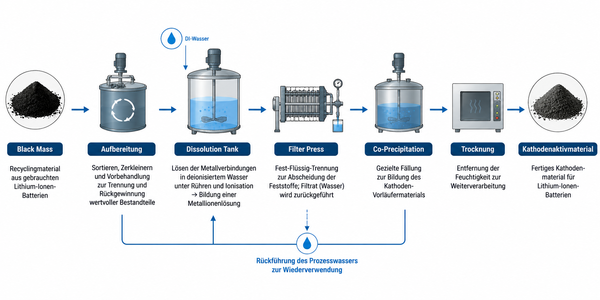
During the washing process, process water is recirculated and reused multiple times. As a result, the concentration of the suspension changes continuously.
This is precisely where one of the greatest challenges in process control lies.
Why Is Concentration So Important?
In the dissolution tank, the concentration of metal ions plays a key role in determining the quality of subsequent particle formation.
If the concentration is too high or too low, it can affect the entire co-precipitation process and lead to variations in product quality.
In many production facilities, the washing process is still controlled based on predefined washing times or discontinuous laboratory analyses.
This can result in:
-
Washing for longer than necessary
-
Unnecessary water consumption
-
Additional energy consumption
-
Lost production time
-
Processes not being utilized to their full potential
Continuous inline measurement, on the other hand, enables process control based on the actual process conditions.
How Does Microwave Concentration Measurement Support the Process?
Continuous microwave concentration measurement monitors the solids content or concentration of the slurry directly in the process – without interrupting the production process.
The measurement is performed continuously between the dissolution tank and the filter press, providing real-time information on changes in the slurry concentration.
This enables operators to optimize their processes in a targeted manner and control them based on actual process conditions rather than relying solely on fixed washing times. (This graphic was generated using AI)
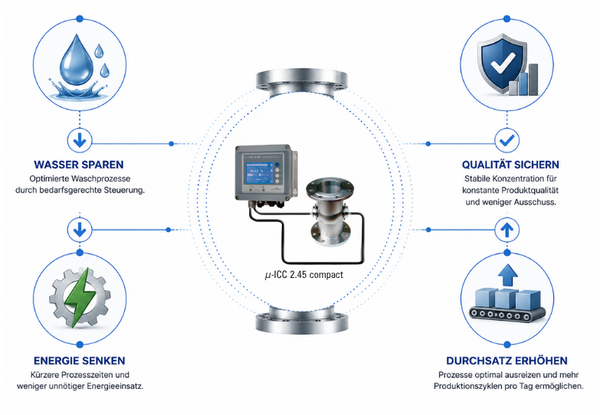
The Benefits:
✔ Continuous real-time process monitoring
✔ Precise concentration control
✔ Optimized washing processes
✔ Reduced water consumption
✔ Reduced energy consumption
✔ Reuse of process water
✔ Consistent product quality
✔ Increased production capacity
Practical Example from CAM Production
A practical example from the production of cathode active materials demonstrates the benefits of continuous concentration measurement during the production process.
In a CAM production line, a microwave concentration measurement system was installed between the dissolution tank and the filter press. There, it continuously monitors the concentration of the slurry during the washing process.
Since the process water is returned to the dissolution tank after filtration and reused, the concentration changes continuously throughout the process. Continuous measurement allows the washing process to be controlled based on the actual concentration rather than relying solely on predefined washing times.
The result:
Continuous concentration monitoring enabled the process control to be optimized and the number of daily production cycles to be increased from approximately eight to up to ten. At the same time, water and energy consumption were reduced and the process was stabilized.
This practical example demonstrates how real-time process data can help control production processes more efficiently, use resources more effectively, and increase throughput in CAM production.
Benefits of Inline Concentration Measurement for CAM Manufacturers
| Benefit | Value |
| Real-time monitoring | Continuous process transparency |
| Reduced water consumption | Optimized washing cycles |
| Lower energy consumption | Shorter process times |
| Stable product quality | Consistent concentration control |
| Less waste | Reproducible process conditions |
| Automated process control | Fewer manual interventions |
| Higher plant availability | More efficient production processes |
| Increased production throughput | Higher plant utilization |
Conclusion
As battery production continues to expand across Europe, the requirements for stable, resource-efficient, and cost-effective manufacturing processes are also increasing.
Continuous concentration measurement plays a crucial role, particularly in sensitive process steps such as the preparation and washing of cathode active materials. It enables more precise process control, can reduce water and energy consumption, and at the same time contributes to consistently high product quality.
For manufacturers of cathode active materials, inline process measurement technology is therefore becoming an important component of efficient and sustainable battery production.
What are Cathode Active Materials (CAM)?
Cathode active materials are the active materials in the cathode of a lithium-ion battery. Among other things, they influence the battery's energy density, service life, charging performance, and safety.
Why is concentration measurement important in CAM production?
A constant concentration of metal ions and solids is crucial for stable process conditions and consistent product quality. Deviations can affect subsequent process steps, such as co-precipitation, and consequently the quality of the cathode material.
How does inline concentration measurement using microwaves work?
Microwave concentration measurement detects changes in concentration directly and continuously during the ongoing process. This makes measurement data available in real time, without the need to interrupt the process for sampling or laboratory analysis.
What advantages does inline concentration measurement offer in CAM production?
Continuous monitoring allows washing and processing operations to be controlled according to demand. This can reduce water and energy consumption, shorten process times, stabilize product quality, and increase production throughput.
Further Reading
Endress+Hauser – Optimizing the Battery Recycling Process
Battery-News – Battery Active Material Production in Europe
Easpring Finland – Cathode Active Material Production in Kotka
European Commission – NEXTGEN CAM: Cathode Active Material Production in Europe
Pall Corporation – Filtration in Cathode Material Production
Produits similaires
Nos ingénieurs d'application vous conseillent de manière personnelle, complète et professionnelle !
Il suffit de nous contacter par téléphone ou par courrier électronique !