Precise concentration measurement with the US-ICC TOF 1500
-
 Fluid.iO Sensor + Control GmbH & Co. KG
- 6 mars 2026
- 6
- 11.1 minutes
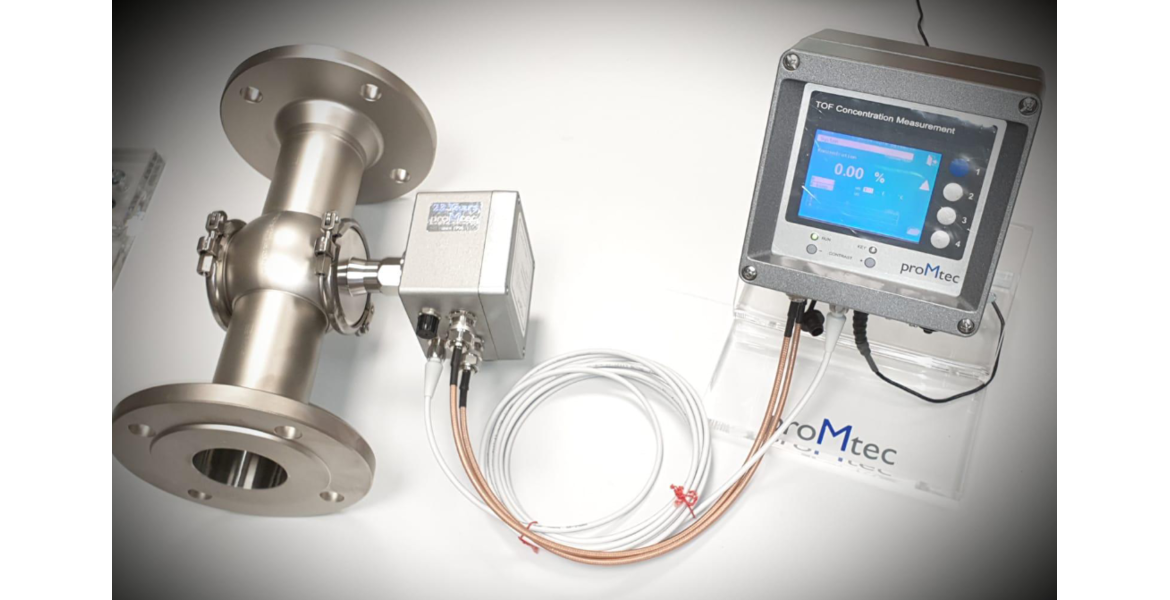
In many industrial processes, the precise determination of the concentration or density of liquids is crucial for product quality, process stability, and efficiency. The US-ICC TOF 1500 measuring system offers a highly precise inline solution based on state-of-the-art ultrasonic technology. By measuring the speed of sound in the medium, the system enables reliable and continuous analysis directly within the process.
Operating Principle: Time-of-Flight Measurement
The US-ICC TOF 1500 operates according to the so-called Time-of-Flight (TOF) principle. Sound pulses in the low kilohertz range are sent through the measurement medium. The time it takes for an ultrasonic pulse to travel a defined distance through the medium is measured precisely.
The sensor has a fork-shaped measuring head. A sound pulse is generated by a transmitter between the two prongs of the fork and detected by the receiver. The speed of sound in the medium can be determined from the measured travel time of the signal.
The speed of sound is a material- and concentration-dependent physical quantity. Therefore, properties such as:
- Concentration
- Density
- Brix value
or other medium-dependent units can be directly inferred from the measured value.
The result is a continuous and high-resolution inline measurement.
Measurement System Setup
The measurement system consists of four key components:
- Transmitter (Evaluation Unit)
- Sensor
- Connection Cable
- Process Connection
This modular structure allows for flexible integration into a wide variety of systems and process environments.
Compact Transmitter with Integrated Signal Processing
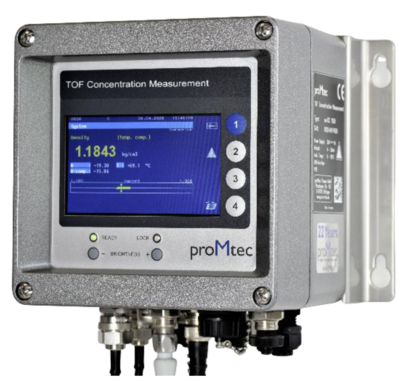
The core of the system is the compact transmitter. It generates the ultrasonic signal, processes the measurement data, and presents the results clearly.
Key features include:
- Compact design with integrated generator for low-frequency ultrasonic signals
- Conversion of digital measurement signals into directly usable process values
- 4.3-inch TFT color display (480 × 272 pixels)
- Soft-touch control panel with four buttons
- Clearly structured and multilingual menus
- Various interfaces are available for integration into existing automation systems:
- 4–20 mA analog output
- Digital communication via Profibus or Profinet (optional)
The transmitter also offers practical service and data functions:
- USB 2.0 interface for software updates, data transfer, and calibration
- SD card slot for storing measurement data and parameter settings
Sensor variants for different pipelines
Two sensor types are available to meet various process requirements.
Sensor Type 1 – Varivent Sensor for Smaller Pipelines
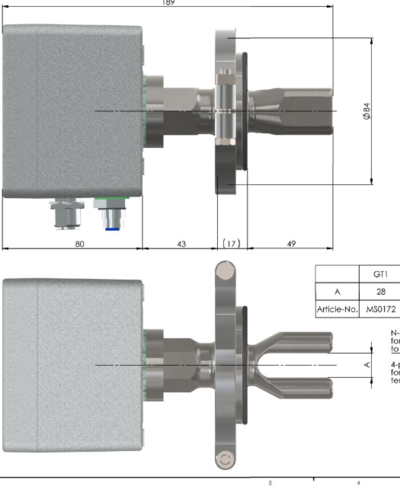
This sensor is designed for pipes from DN40 and is installed via a Varivent flange connection. The measuring fork is made of stainless steel 1.4571 (AISI 316 Ti) and is therefore also suitable for demanding process media.
Sensor Type 2 – Flange Sensor for Larger Pipelines
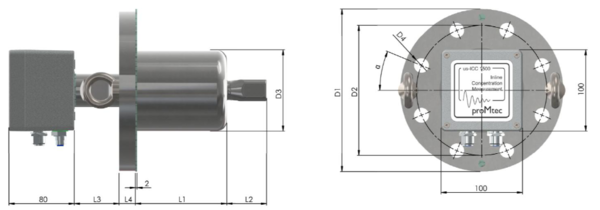
For larger pipe diameters, a sensor variant with a DN65 or DN80 flange connection is available. This version enables stable installation in systems with higher flow rates.
Measurement Process in Detail
The installation and calibration of the US-ICC TOF 1500 are relatively simple once the technical parameters of the process have been defined.
- The measurement process takes place in several steps:
- The transmitter generates ultrasonic pulses.
- The pulses propagate through the measuring medium.
- A receiver registers the incoming signal.
- The system calculates the transit time of the sound pulses.
The transit time is measured in microseconds (µs) and then converted to the speed of sound (m/s). This raw data forms the basis for further analysis.
In the evaluation unit, the raw signals are converted into application-specific process values, for example:
- Mass percent (mass %)
- Volume percent (volume %)
- Brix
or other media-dependent units
Advantages of Inline Speed of Sound Measurement
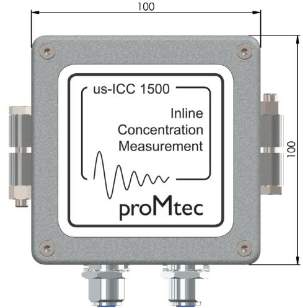
Measuring the speed of sound offers several advantages over conventional analytical methods:
- Continuous inline measurement without sampling
- Fast response time
- High measurement accuracy
- Robust sensors for industrial applications
- Easy integration into existing process control systems
This makes the system particularly suitable for applications where concentrations or compositions in liquids need to be reliably monitored.
Applications – concentration of liquids
| Food & beverage: | chemical industry |
|---|---|
| Sugar factory – Brix of sugar juice at evaporator station or tank | Ethanol, methanol concentration |
| Starch concentration | Bases & acids concentration |
| Brewery: wort boiler & wort cooler (plato) | Alkaline solutions |
| Salt – salt solution & crystals revenue | Adblue production |
| sodium silicate |
Conclusion
The US-ICC TOF 1500 is a high-performance measurement system that precisely measures the speed of sound in liquids and derives important process parameters from it. The combination of robust sensors, a compact evaluation unit, and flexible interfaces makes this system a versatile solution for modern process analytics.
Companies benefit from continuous and precise monitoring of their media – directly in the process and in real time.
Produits similaires

Nos ingénieurs d'application vous conseillent de manière personnelle, complète et professionnelle !
Il suffit de nous contacter par téléphone ou par courrier électronique !