Explosion protection in the process industry: EX zones, ATEX and sensor technology explained simply
-
 Fluid.iO Sensor + Control GmbH & Co. KG
- 20 mars 2026
- 10
- 12.8 minutes
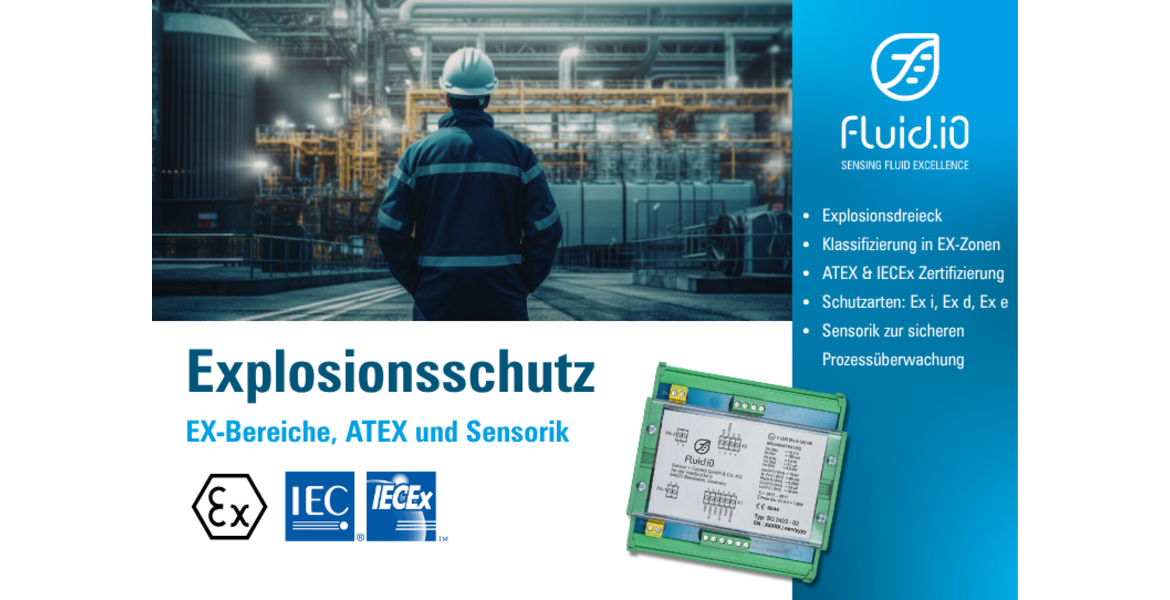
Many industrial processes create conditions that can lead to explosive atmospheres. Particularly in the chemical, pharmaceutical, and food industries, flammable gases or vapors can form a dangerous mixture when combined with oxygen. If an ignition source is also present, an explosion can occur – with potentially serious consequences for employees, equipment, and production processes. To minimize such risks, strict international regulations govern explosion protection (EX protection). These regulations cover both plant design and the equipment and sensors used. But what does explosion protection actually mean for companies – and what role do sensors and measurement technology play in EX areas?
When does an explosion occur? The explosion triangle
An explosion occurs when three conditions are met simultaneously. This principle is often referred to as the explosion triangle.
The three necessary factors are:
1. Combustible material
For example, gases, vapors, mists, or combustible dusts.
2. Oxygen
Usually from the surrounding air.
3. Ignition source
For example, electrical sparks, hot surfaces, or electrostatic discharges.
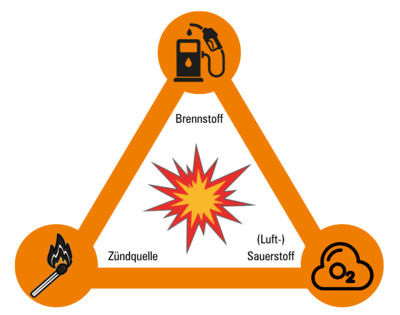
When these three components come into contact, a rapid chemical reaction can occur, releasing large amounts of energy within a very short time. The sudden pressure increase and intense heat generation can cause significant damage.
Typical ignition sources in industrial plants include:
electrical devices and equipment
mechanically generated sparks
hot surfaces
electrostatic discharges
electromagnetic radiation
lightning strikes or friction
To minimize these risks, devices, sensors, and plant components must be specially designed and certified for use in potentially explosive atmospheres (EX areas).
EX zones: Classification of potentially explosive atmospheres
A key component of explosion protection is zone classification. It serves to systematically assess the risk of explosive atmospheres and to determine appropriate protective measures.
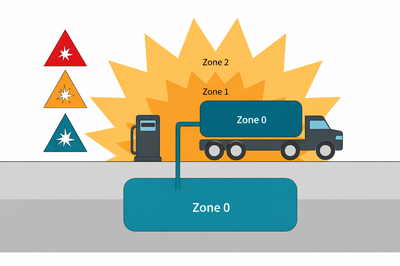
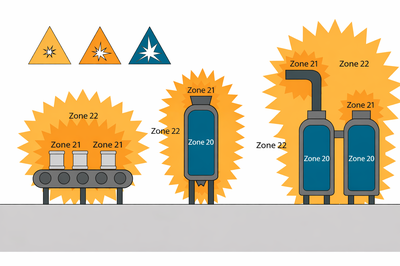
Areas at risk of explosion are classified into so-called EX zones.
Gas atmospheres |
Dust atmospheres |
 |
 |
An explosive atmosphere is present continuously, for long periods of time, or frequently.
An explosive atmosphere may occur occasionally during normal operation.
An explosive atmosphere does not normally occur during normal operation, or only for short periods. |
A similar classification applies to combustible dusts:
|
The specific zone determines which equipment may be used there and what protection levels are required. The higher the risk of an explosive atmosphere, the stricter the requirements for the technology used.
ATEX and IECEx: Important standards in explosion protection
Equipment and components for use in hazardous areas must comply with international safety standards. Two of the most important sets of regulations are ATEX and IECEx.
ATEX - Explosion protection in the European Union
The ATEX Directive (2014/34/EU) forms the legal basis for equipment and protective systems used in potentially explosive atmospheres within the European Union (see the official directive).
It specifies requirements for the design, testing, and certification of equipment used in hazardous areas.
ATEX-compliant products are generally identified by the following features:
- CE marking
- EX symbol
- Equipment group and category (e.g., II 2G)
- Temperature class
- Identification number of a notified body
A typical example of an EX marking can be found on the nameplate of a certified device – this contains all relevant information for safe use in the respective application area.
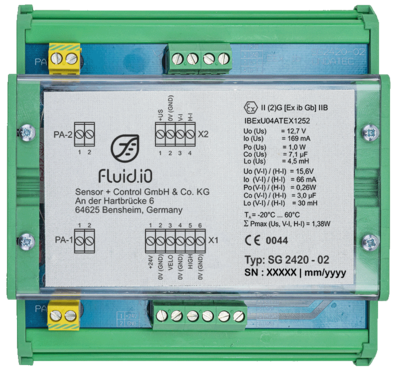
Important: Correct and complete EX marking is critical for safety. Incorrectly or incompletely marked devices pose a significant risk and must not be used.
IECEx - International Certification System
The IECEx system is a globally recognized certification system for explosion protection equipment. It is based on the international IEC 60079 series of standards, which defines technical requirements for equipment used in potentially explosive atmospheres.
The goal of IECEx is to facilitate the international recognition of explosion protection certifications and simplify the global trade of safe equipment.
While ATEX is legally mandated within the EU, IECEx adheres to internationally harmonized technical standards and is used in many countries worldwide.
Types of protection in explosion protection
To prevent devices from becoming ignition sources themselves, various technical protection principles are used in explosion protection.
The most important types of protection include:
-
Intrinsic safety (Ex i)
Electrical energy is limited to prevent the generation of ignitable sparks or impermissible temperatures.
-
Flameproof enclosure (Ex d)
A potential explosion is contained within a robust housing, preventing flames from escaping.
-
Increased safety (Ex e)
Design measures prevent sparks from occurring or components from reaching unacceptably high temperatures.
The appropriate protection rating always depends on several factors, including:
- the specific explosion-proof zone
- the medium present (gas or steam)
- the process conditions
- the type of equipment used
The role of sensors in hazardous areas
Sensors and measuring systems such as inline viscosity sensors or level sensors are crucial for safe and stable industrial processes.
They enable the continuous monitoring of important process parameters such as:
- Viscosity (Fluid.iO Viscosity)
- Pressure (Fluid.iO Safety Switching Devices)
- Flow Rate (Fluid.iO Flow Meters)
- Level (Fluid.iO Level Gauges)
- Material Properties of Fluids
Level measurement technology plays a particularly important role in hazardous areas (EX zones), as it helps to detect critical conditions early and to control processes safely.
In potentially explosive atmospheres, sensors must be designed so that they do not pose an ignition source.
Therefore, the following factors are taken into account during development:
- Limitation of electrical energy
- robust and suitable enclosure designs
- certified components
- clear labeling and documentation in accordance with ATEX or IECEx
At Fluid.iO, we have decades of experience in developing sensor solutions for demanding industrial applications – including those in hazardous areas. Customers can rely on our products to meet all relevant requirements and operate reliably.
Conclusion: Safety begins with selecting the right equipment
Explosion protection is a key component of modern industrial plants. Only the right combination of risk assessment, zone classification, and certified technology ensures safe process operation.
For plant operators, this means:
Even during the planning phase of measurement and automation technology, it is essential to ensure that the devices used are suitable for hazardous areas (EX zones) and correctly labeled.
Selecting appropriate sensors is crucial for minimizing risks while simultaneously guaranteeing stable and efficient processes.
Would you like to learn more about our EX-certified sensor solutions?
Visit our product pages or take a look at our certificates – there you will find an overview of all relevant ATEX and IECEx approvals:
An overview of our sensor solutions for various applications can be found here:
Produits similaires

ViscoScope® VA-100
Viscosimètre de processus en ligne


T-200.F Ex
Sécurité anti-débordement pour cuves avec agrément Ex
Nos ingénieurs d'application vous conseillent de manière personnelle, complète et professionnelle !
Il suffit de nous contacter par téléphone ou par courrier électronique !